My shadow’s the only one that walks beside me
The Science: (notes added by me will be denoted within [] blocks)
1Chromosomes, found in all body cells, contain genes. Genes provide specific instructions for body characteristics and functions. For example, some genes determine height and hair color. Other genes influence language skills and reproductive functions. Each person typically has 23 pairs of chromosomes. One of these pairs (sex chromosomes) determines a person’s sex. A baby with two X chromosomes (XX) is female. A baby with one X chromosome and one Y chromosome (XY) is male.
2The most common abnormal chromosomal condition in humans is sex chromosome aneuploidy (SCA), or a variation in the usual number of sex chromosomes. Usually, there are 22 pairs of numbered chromosomes (from 1 to 22) and a pair of sex chomosomes (X or Y chromosomes) that normally give humans a total of 46 chromosomes. In human males, the X and the Y chromosomes form a pair, with the mother’s egg always contributing an X chromosome. The sex of the baby is determined by the sex chromosome of the father’s sperm, which can contained either an X or a Y chromosome. If the father’s sperm contributes a Y to the pair, the embryo develops as a male; if the sperm contributes an X to the pair, the embryo develops as a female.
When one extra chromosome is present, that pair is instead a threesome, known as a trisomy. Trisomies are often not survivable, and the embryo will spontaneously abort, or will be lost in miscarriage. Even when the trisomy condition is survivable, as it is with Trisomy 21 (Down syndrome) and Trisomy 18 (Edwards syndrome), the babies that are born have significant intellectual disability as well as serious health problems. SCA is the most survivable of the trisomies, and is not often associated with devastating disability. SCA affects an estimated 1 in 500 live births. By comparison, Down syndrome affects approximately 1 in 800 and Edwards syndrome, only 1 in 6000.
Klinefelter Syndrome
1Klinefelter syndrome (KS) is a group of conditions that affects the health of males who are born with at least one extra X chromosome and is estimated to occur in approximately 1 in 600 male births. Most males with Klinefelter syndrome (47,XXY), also called XXY males, have two X chromosomes instead of one. The extra X usually occurs in all body cells. Sometimes the extra X only occurs in some cells, resulting in a less severe form of the syndrome. This is called a mosaicism, and is very common. Rarely, a more severe form occurs when there are two or more extra X chromosomes.
2Less common SCA conditions include Trisomy X, (47,XXX) or a female with three X chromosomes, which occurs in approximately 1 in 1,000 female births, and 47,XYY (occasionally called Jacob’s syndrome), a male with two Y chromosomes, which occurs in approximately 1 in 1,000 male births. Other sex chromosome aneuploid conditions include variations of Klinefelter syndrome and Trisomy X where there are two or more additional X or Y chromosomes, instead of just one additional X or Y chromosome, a these are much less common.
What are the signs and symptoms of Klinefelter syndrome?
1Signs and symptoms can vary. Some males have no symptoms but a doctor will be able to see subtle physical signs of the syndrome. Many males are not diagnosed until puberty or adulthood. As many as two-thirds of men with the syndrome may never be diagnosed. Many men with mosaicism for XXY males do not have all of the signs and symptoms listed below.
2The almost universal finding in males with KS is testicular failure, which is the inability to make sufficient numbers of sperm and, in most, low testosterone levels. Becoming a father may be possible with complex and sometimes expensive treatment [not possible for me]. Although most adolescents with KS enter puberty normally, and begin producing testosterone, puberty is often incomplete because the testes begin to fail in the mid-teens. While most men with KS have a penis of normal size [thankful for this!], the testicles do not increase in size and are characteristically small. We also know that while many younger teens do produce viable sperm in the ejaculate through their mid-teens, this usually falls off precipitously early in puberty.
The other symptoms that characterize many males with Klinefelter syndrome include speech delay, low muscle tone and some difficulty with fine and gross motor skills, learning disabilities and social skill difficulties, including shyness and social withdrawal. Although boys with KS almost always develop functional language, expressive language, particularly written expression, may remain a challenge through life. Attention deficit disorder is more common in KS than in the general population, as are mood disorders and anxiety. Again, symptoms are highly variable from one individual to the next. While IQ may be slightly lower than that of siblings, on average about 15 points, intellectual disability (the preferred term for mental retardation) is rare, affecting less than 10 percent of those diagnosed with 47,XXY.
Signs and Symptoms by Age Group
* – I will display an asterisk on the ones that I had or do have
1Infants and young boys may have:
- clinodactyly (curved little finger)
- hypertelorism (wide-spaced eyes)
- hypospadias or micropenis
- club foot / feet *
- polydactyly (having fingers or toes numbering greater than 5)
- Weak muscles *
- Speech and language problems, such as delayed speech *
- Problems with learning and reading *
- Problems fitting in socially *
- Mood and behavioral problems
Adolescents may ALSO have:
- Small, firm testicles *
- Enlarged breasts, called gynecomastia
- Long legs but a short trunk *
- Above-average height *
- Reduced muscle bulk *
- Sparse facial and body hair *
- Delayed puberty *
- Low energy levels *
Adults may ALSO have:
- Low testosterone (male hormone) levels [for me, only after age 37] *
- Infertility from a lack of sperm *
- Decreased sex drive [after age 37] *
- Problems getting or keeping an erection [after age 37] *
- Other difficulties, such as being unable to make plans or solve problems *
How is Klinefelter syndrome diagnosed?
1Diagnosis is based on a physical examination, hormone testing, and chromosome analysis. The syndrome can also be diagnosed before birth but testing is not routinely done at that time.
When I was 36/37, I was dating a girl named Becky Frank Olsen who already had 2 kids ages 6 and 10. She mentioned that she would not object to having a third child with my complexion though of course, that isn’t in our control. However, I started noticing a trend that I felt that I needed to get checked out:
Between the ages of 19 and 25, I dated this one girl named Carrie Segar on and off. We were together for a couple of years, shit happened, she left, she had a kid, came home, we got back together for another couple of years and were engaged, and then things didn’t work out in the end (she gave me an ultimatum that I could not accept).
I met Briana Van Parys at the age of 30 and I believe we started dating when I was 31. We were together for 3 years and engaged, shit happened, she moved out, she had two kids, my best friends move to her home town, we got back together, and we’ve been together for nearly another 2 years though presently on a break.
I’m very surprised that I have never contracted any STDs considering the number of women that I have had intercourse with without using any type of protection. And yes, I do get tested (usually) after every partner.
The result from the testing done by the urologist is the news that I had shared way back in 2013. The urologist however only disclosed that Klinefelter syndrome was responsible only for the infertility and lack of testosterone production so I thought nothing of it and went 10 years before I really decided to research the damn thing. I started researching it in June 2023.
Health Problems Associated with Klinefelter Syndrome
Klinefelter syndrome can lead to weak bones (osteoporosis), varicose veins, and autoimmune diseases (when the immune system acts against the body), such as lupus or rheumatoid arthritis. XXY males have an increased risk for breast cancer and cancers that affect blood, bone marrow, or lymph nodes, such as leukemia. They also tend to have excess fat around the abdomen (which raises the risk of health problems), heart and blood vessel disease, and type 2 diabetes.
What is the treatment for Klinefelter syndrome?
Treatment can help males overcome many of the physical, social, and learning problems that are part of the syndrome. Males with Klinefelter syndrome should be seen by a team of health care providers. The team may include endocrinologists, general practitioners, pediatricians, urologists, speech therapists, genetic counselors, and psychologists. Surgery may be needed to reduce breast size. With treatment, men can lead very normal lives.
Experts recommend testosterone replacement, starting during puberty, for proper development of muscles, bones, male sex characteristics such as facial hair, and sexual function. Continued treatment throughout life helps prevent long-term health problems. Testosterone replacement does not cure infertility, however. Infertility treatments require specialized and costly techniques, but some men with Klinefelter syndrome have been able to father children.
Credit:
1https://klinefelter.jhu.edu/
2”Living with Klinefelter Syndrome (47,XXY), Trisomy X (47,XXX), and 47,XYY” by Virginia Isaacs Cover MSW, 2012.
Turns out that all my health ailments can be attributed to the Klinefelter Syndrome. Every. Single. One. Here is the list:
Fuck.
Posted on FaceBook on July 15, 2023:
People use Facebook for different reasons. Some people are ultra private, some are paranoid due to external forces, some only post good moments, some only post memes, some only vent, and some simply bare all. I’ve decided to just bare all because who truly gives a f*ck (except for select ppl I physically talk to). [I hide these bare alls from family and the Indian Community though 😎.]
I had a vulnerable moment last night and I posted it on Facebook. After a few comments, I changed the privacy setting to “Only Me” so if you did comment, don’t worry, I did not delete the post because your insights are valuable to me.
10 years ago I was diagnosed with something and I was only told that it has caused me to be infertile. The doctor who found this out by multiple tests did not go into further detail as that was the reason I went to see them. I found a book about it last month which I first handed to my dad to read because it only takes him a day or two to read a book while it takes me forever and a day. And plus I figured he would want to learn more as he was with me that oh-so-fine day I received those results. After he completed the book, he discussed with me that he now understands why I am the way I am and that it explains my behaviors, etc, while growing up in great detail. My mom expressed that she felt bad but I told her that it is not her fault due to this “error” being a random genetic event as it is not hereditary.
Anyway, within the past year or so, some of the psychiatric “fault” components of that syndrome have really been making themselves known. I’m talking about ADHD in full force, anxiety disorders, depressive disorders, and the works. I’ll post more in my journal which I haven’t updated in over 3 years.
I’ve been feeling rather lonely in my current relationship. I’ve expressed this to Briana but it just seems like she doesn’t care. She doesn’t communicate with me and she sleeps at the oddest hours. She says she can’t help it but at the same time, she doesn’t seek help for it which confounds me because… well… if you know, you know. But you probably don’t know because it isn’t my story to tell. I will text and text discussing my day or whatever and sometimes it will be days before she reads them and responds. (I call too but it usually goes to voicemail.). I’ve been in relationships before with single women with small kids and never have I ever experienced this loose connection. It was not like this during the first year or so. So, of course, negative thoughts circulate through my mind (a curse) and it makes me think that she wants to break up with me. (Research Rejection Sensitive Dysphoria (I have this too)) But the thing you have to know about Briana is that she will never be the one to do it – she wants the other party to do it. Probably something about accountability or whatever. I don’t think she realizes that her in-action effects (affects?) other people. That’s how I feel but I bet that will get invalidated too (if you know, you know but you probably don’t know because I don’t discuss it).
Don’t get me wrong though, she’s not a monster.
I’ve signed up for a 13 session curriculum which teaches skills across four main areas: mindfulness, interpersonal effectiveness, emotional regulation, and distress tolerance. It’s a group for those struggling with relational issues, mood dysphoria, anxiety, depression, BPD, chronic stress, and more.
To be continued…
The other day, Kristina was getting sad and mentioned that she wanted to keep Natalie sheltered from having daddy issues. But as I read more and more about what daddy issues are, I’m convinced that K actually has them too even though her father passed away when she was an adult at age 21.
Credit: https://postmalesyndrome.com/
Kristina doesn’t fit the whole 15 point list and neither does Natalie. Natalie does however go from boy-to-boy within a month’s time and she’s only 13. She’s had 7 or 8 partners so far. She has a good head on her shoulders but I fear that for the sake of staying together with a boy she really likes, she will eventually loosen her values for said boy. She may even follow her mother’s footsteps and get pregnant at the age of 16. Hopefully under different circumstances if this is the case. I remember that it was only 1.5 years ago when she said that she wouldn’t date until she was out of high school. Times change so quickly.
Summer is around the corner. This means more summer teen parties filled with games like Seven Minutes of Heaven, Truth or Dare, online Omegle-style games over FaceTime or other media, Sexting which is highly popular in her age group, etc.
I may or may not be involved further with Natalie’s upbringing. Kristina seems to want to hold all the cards when it comes to Natty. I’ve tried but seem to get the shaft when making decisions for Nat. I fear I’m more used when it comes to finances. Not anymore though – if I am not allowed to make decisions, I will back away from paying for things. If K is so bent on raising her teenage daughter because she didn’t have a hand in raising her son, then she can do the whole nine yards. Natty’s soccer league costs at least $450 per season. Good luck with that.
In any case, I’ve never been in a relationship with someone quite like this one. We have so many arguments because I am rigid and stable and K is more hippy-like never really having a grasp on anything 100%. When it comes to long-term relationships of 3+ years, I don’t think Briana and I ever truly had a fight but Carrie and I did though not as intensive as K and mines’. I don’t know if that last word is correct, apostrophe and all. The problem lies because we do not communicate properly. I don’t believe that we have had one serious conversation about us, about goals, about raising or disciplining Nat, about financial matters, etc. Each time I try to bring something up, K has the same reaction every time where the excuse is either about work or ‘relaxing’ and emotional level goes from 0 to 10 in a matter of seconds … for the last three fucking years.
There is never a middle ground. Things are always either black or white, never gray. It’s always either all or nothing, no compromising…
Kristina tends to control the conversations. She will talk about whatever she wants to talk about and I don’t create a fuss. I’ll even pause my TV program if she interrupts. But when I bring something up? Fuhgeddaboutit! WWIII. I’m going to attempt to react the way K does for future conversations that she brings up so she can see just how irritating and annoying those reactions can be.
We had a fight yesterday. See conversation after she went from 0 to 10 within 10 seconds…
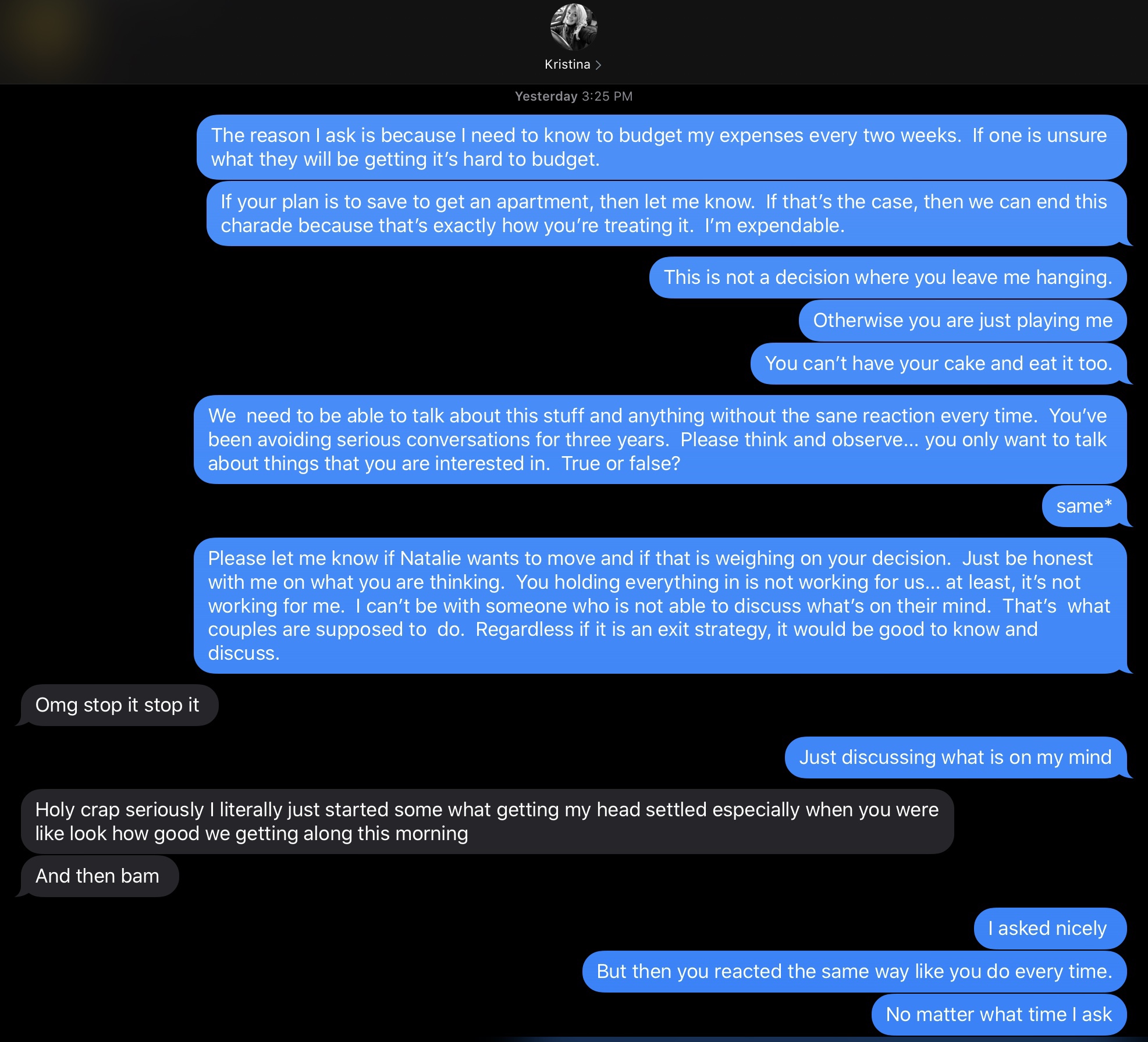
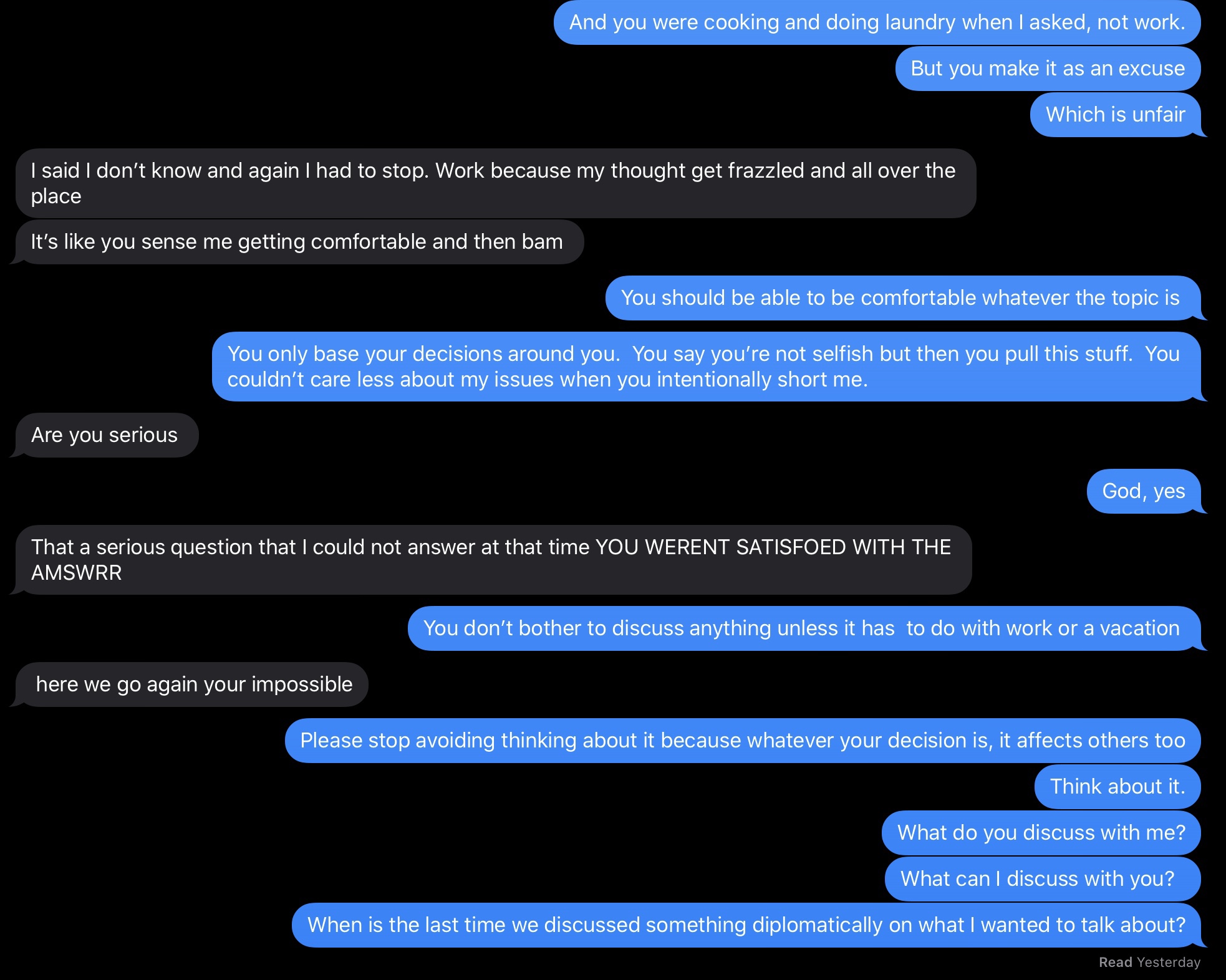

🤷🏽♂️
I’ve decided that I want to get some favorite lyrics as tattoos on my left arm and leave the artwork to my right arm. The lyrics I’ve chosen are:
Every year is getting shorter; we never seem to find the time.
Children growing up; old friends getting older. Freeze this moment a little bit longer…
You my friend, I will defend. And if we change, well I’ll love you anyway.
I’ve been having my list of problems in this current relationship/friendship/roommate situation that I’ve put myself in. Another case of me acting too rash and thinking I’d benefit from having a live-in girlfriend. Not benefit monetarily or sexually but as in companionship on an everyday level. Boy, what a ride it has been. Of course, it takes two to tango so she had a choice as well on whether to move in so the blame cannot completely be on me. This was 3.25 years ago.
Mike N. basically summed me up based on my relationships and all and said that I have something called a “Savior Complex”. While I don’t believe that I am better than anyone else, the following article explains me and what has happened to a T:
At first, the term “Savior Complex” may have a positive connotation. However, when you learn more about it and the underlying motivations and impact on others, it is clear that this behavior pattern can be problematic.
According to the blog PeopleSkillsDecoded.com, the savior complex can be best defined as “A psychological construct which makes a person feel the need to save other people. This person has a strong tendency to seek people who desperately need help and to assist them, often sacrificing their own needs for these people.”
Many individuals who enter into caring professions such as mental health care, health care and even those who have loved ones with addictions may have some of these personality characteristics. They are drawn to those who need “saving” for a variety of reasons. However, their efforts to help others may be of an extreme nature that both deplete them and possibly enable the other individual.
The underlying belief of these individuals is: “It is the noble thing to do.” They believe they are somehow better than others because they help people all the time without getting anything back. While motives may or may not be pure, their actions are not helpful to all involved. The problem is that trying to “save” someone does not allow the other individual to take responsibility for his or her own actions and to develop internal motivation. Therefore, the positive (or negative) changes may only be temporary.
The Second of The Four Agreements by Don Miguel Ruiz is “Don’t Take Anything Personally.” This book chapter and the following quotes teach key concepts that may provide helpful guidance for those struggling with savior complex tendencies:
“You are never responsible for the actions of others; you are only responsible for you.”
“Whatever you think, whatever you feel, I know is your problem and not my problem. It is the way you see the world. It is nothing personal, because you are dealing with yourself, not with me.”
“Humans are addicted to suffering at different levels and to different degrees, and we support each other in maintaining these addictions”
So what are solutions for avoiding the “savior” trap with relationships and clients?
- Process emotions with friends, family and/or other staff members.
- Set boundaries with other individuals that allow you to balance caring for them with trying to “save” them.
- Say “maybe” or “no” before saying yes in order to give yourself time to weigh options.
- Slow down enough to be mindful of choices.
- Reach out for support from a therapist or coach in order to receive an objective assessment of your interpersonal issue.
- Let your loved one, friend and/or client take responsibility for their actions.
- Do not work harder than your friend, loved one and/or client.
- Do the best that you can do to support the individual and then “let go” of the results.
- Redefining “helping” and “caring.”
What does “helping” mean to you and for this individual?
- Asking questions
- Backing off
- Simply listening
- Offering action steps and coping skills instead of doing the work for them
Ask yourself:
- Am I helping this person by avoiding natural consequences?
- Is this decision made to keep them “happy” or for their overall health?
- Is my action helping them to get better or me to feel better?
- Am I being invited to help?
- Do I “want” to or have to do this?
What are your fears about not helping, and can you challenge them?
- The family or others will not like me.
- People may complain or not be happy, or my job may be in jeopardy.
- I will feel like I am not being effective as a loved one or at my job.
- I feel like I am not able to help.
- I am not doing the best that I can.
- I am missing something obvious.
Credit: https://www.psychologytoday.com
I can honestly say that I’m depleted and that after 3.25 years I have noticed that I am a changed man – for the worse. It first started when we were sleeping together (as in sleep, not sex) and she mentioned that she can’t sleep due to my snoring. What did I do? I gave up my master bedroom to her and slept wherever I could for a few weeks. Treadmill. Couch. Floor. Eventually I went to sleep downstairs in the media room that I spent a significant amount of cash to renovate into. I removed the couch and then put in an adjustable frame queen sized bed. That became my bedroom. Even before this Coronavirus mumbo jumbo happened, I was in my very own isolation.
A huge warning sign to me should have been that whenever I came upstairs, she would yell at me asking why I’m up there, etc. I should have known then that I was being used. At least, I felt like I was being used. Again, savior complex – at least I’m able to give this person and their daughter better accommodations. And since we were romantically-involved, though I felt I was the only one attempting the romance part, I didn’t charge any rent. My friends and parents told me that was a “no-no” and that even though I invited her to move in, she should have offered to pay something for residence. One would think that if she wasn’t interested in the romance or being boyfriend/girlfriend then they would jump on the bandwagon and pay for living there, right? Yea? No.
Another example of me coming in to save the day was offering her a loan to pay off her car which had an APR of 24.99%, the highest possible interest rate in NYS. And on top of that, co-signing a car from CarMax. Thankfully she’s been paying that down regularly though there were a couple of missed payments that I had to tweak. And then she was having some major pain in her mouth due to an incident by her abusive ex-husband (who she makes excuses for still). Daughter wants nothing to do with that guy. I loaned her $38,000 to give her an entire teeth implant renovation. Of course, initially when it came to it, she had no problem with accepting the help to improve her quality of life. She mentioned after it was done that people definitely noticed. But then, over time when it came down to paying it back, she had a problem with it and keeps saying, “I never should have had it done” or “you never said I had to pay it back”. Her recollection of events is vastly different than mine. I was going to use that money to renovate my kitchen so that’s on hold.
And then there’s Jamaica. I said that I’ll pay for the trip there and back along with the hotel and yacht expenses (we went with a group of couples). I asked her if she could pay for the shopping and other spending while we were there and she said okay. Lo and behold, I ended up being the sole spender aside from some trinkets she got for her family. Did I get pissed about that? You bet your ass and I still bring it up to this day. She just shrugs it off.
Am I naive and gullible? Fuck yea! <– not an admirable quality unless you are the user.
She mentions that she likes that I’m not aggressively sexual like most of her exes had been. In fact, experiencing all of the above and more has put my sex drive at an all-time low. Who knew that it would all be a lie? During our relationship, she’s traded nude photos with other men and has had dirty talk with them. She doesn’t consider that cheating but EVERYONE ELSE does. She had it hidden but her daughter, Natalie (N), found out about those texts and thought the honorable thing to do was to let me know. Bless her heart. But instead of communication in regards to it and how she could do such a thing to me, I keep getting a “get over it” response. Her daughter even found a whole sensual conversation between her abusive biological father and mother (which took place on her birthday no less).
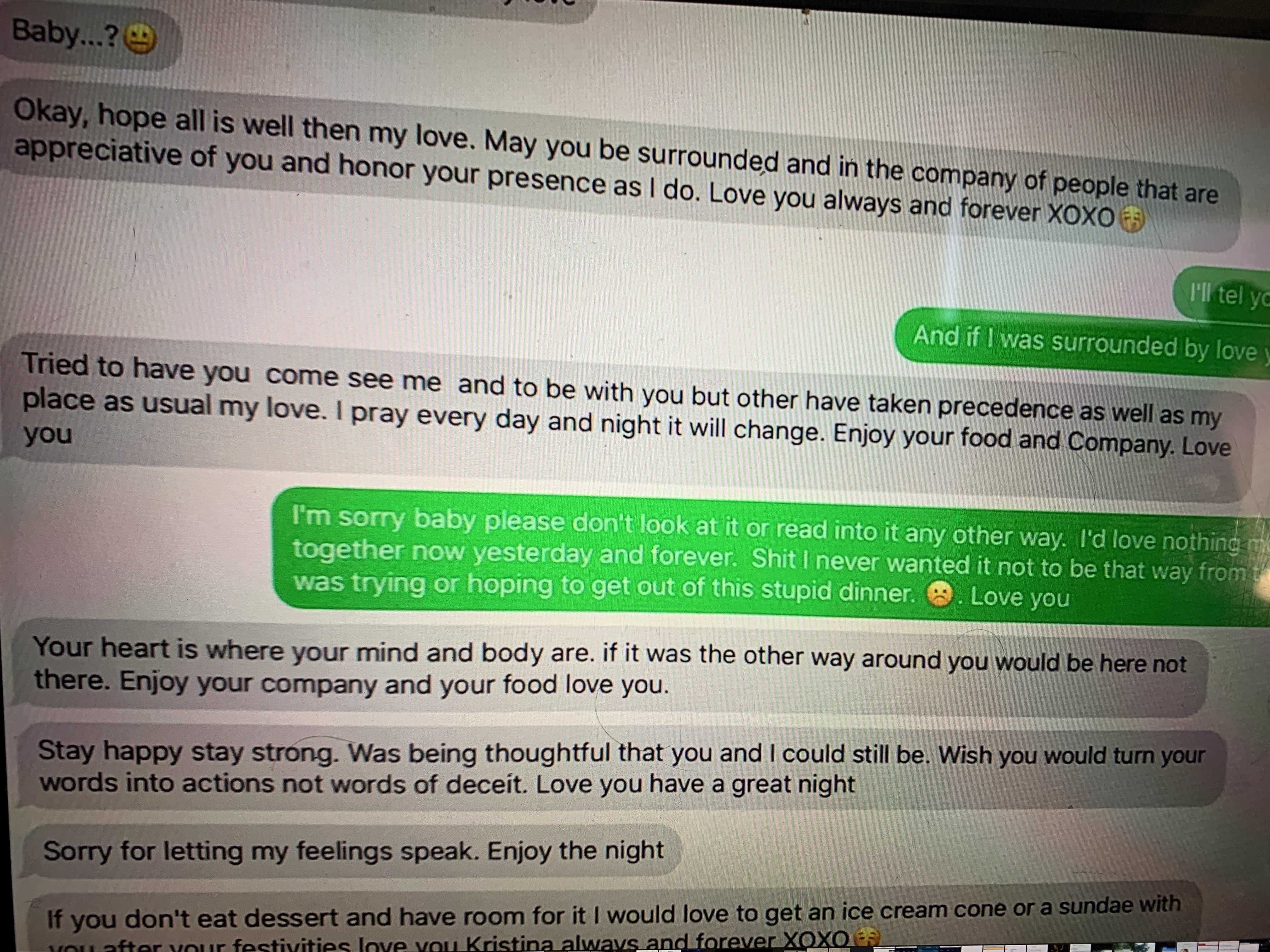
K, of course, denies it ever took place and the ex somehow placed it on her iPad. N swears that she’s seen K writing to BB before that happened but K says that N is lying. K also said that N has lied about this other guy Ian (while I was in India during December 2018) who I conveniently have never met. Oh, it gets even better, one of the guys she was trading the nude photos with was in my house while it was all happening. I even have photos of the texts and the dates they were sent.
Am I naive and gullible? Fuck yea! Here’s to me actually wanting something to work. I’m 43 and I have a list of medical conditions where I fear whether anyone would be willing to take them on. Here’s to her getting away with murder without actually killing anyone.
To be perfectly honest, she makes me feel like I owe her something even after all I have done.
We don’t communicate. We are never on the same page when it comes to life goals, raising N, disciplining N, or anything. What K doesn’t take in is that N and her are a package deal. Am I concerned about N? You bet. Do I get a little obsessive when it comes to N? Yes but only because N doesn’t have any sort of routine or discipline and her mother lets her be on electronics 24/7. She (N) doesn’t ever do any homework at home. Rather she’s on her iPhone or her Xbox when she gets home from school all the way until she goes to bed. She befriends all sorts of people on her Snapchat. She said the oldest person she’s added was a 53 year old man who ended up asking her for nudes and she thankfully quickly blocked. I am willing to bet K didn’t know any of that until I told her. How can you study for a unit test during one study hall?
Lies, lies, and more lies. Or vague manipulative truths. That’s all I get.
I’ve decided to adopt Mike N’s advice where I should be saying, “Not my problem.” I gave N the screen-time passcode to her phone and I’ve asked her to stop sharing her location with me. I’ve reset the password on SchoolTool which will go to K and I’ve requested K not to share it with me. I’ve told N that she won’t have to worry about impressing me or doing good in school for fear of consequences because if I can’t check, I won’t know. And she probably won’t have to worry about consequences from her mother because really? I’ve told K to remove me as an emergency contact at N’s school and also to remove me as a pickup person. I’ve told K that if N misses the bus, it will be her responsibility to take her to school. Not my problem. I will probably be told to go fuck myself or questioned as to how I can give up on this child even though I’m never listened to or acknowledged in the first place. K keeps saying that N loves me and that I am important to N probably in an attempt to manipulate my emotions. Whenever K says that N says something, the response I get from N is “bruh I never said that”. N doesn’t make it evident that those things are true anyways. She will tell a guy “I love you” after their one month anniversary but those three words are never uttered to me and we have known each other since October 2016. So much for all the love and attention I have given her. Is she playing me too? The only times she comes to me is if it has to do with screen-time or WiFi or if she wants something. She will only do something around the house if she benefits from it somehow. Whatever happened to children obeying their parental figures without talking back or expecting something in return? Anyway, not my problem.
K has said that I’ve changed. Yes, I have. I’m done with this fuckin’ Savior Complex bullshit.
Documenting:
March 18, 2020
Had a crazy one-hour+ long 160 bpm A-Fib attack tonight associated with light-headedness, dizziness, and cold sweats. Event started roughly at 7:15 PM. Eventually passed out at roughly 8:15 PM and woke up around 10:15 PM. BPM after waking up was an average of 98 BPM.
March 24, 2020
As I was drying myself after taking what some may refer to as a “very hot shower”, my throat tightened tighter than I had ever felt before. I bent downwards like an almost standing up fetal position. And then I fell over to my side as I grasped my throat.
Since I couldn’t yell out because 1) I didn’t feel I could talk and 2) Kristina (K) was on the phone with work (everyone knows DnD her when she is working from home), I started knocking on the bathroom vanity in the hopes she would hear it coming from inside the house. Benji, our chihuahua peeked his head in and immediately started on a barking frenzy which sparked barking from Bella, our golden retriever, outside. It took quite a few minutes before K responded because the knocking was unanticipated and also she was completely in the zone on her work call. Luckily the symptoms dissipated when she found me semi-unconscious on the floor.
I’m going downhill. It’s only a matter of time.
I wonder…
Back when I was feeling uber-down, at the time I wrote the most recent posts, I had shared my blog with my PCP. I had requested to have my medication increased to twice a day rather than simply once daily. After reading it, this is the response I received:
Hi (me),
I was impressed in so many ways after reading your blog…It’s easy to see your big heart, and all the love you want to give the world (and a partner). Also, you are an honest, clear-eyed and fearless observer of yourself and others, though I think you might be a little hard on yourself (the voice of depression, perhaps). I hope you can send a little more of your love your own way. And also you are a really good writer. Your writing is graceful and clear. And I love the way you include quotes…
Reading your blog also gave me some new thoughts about the distress you are experiencing. This may sound weird and we may want to explore this more when we get together, but I’m wondering if what you’re experiencing is more spiritual distress than a psychological or mental health problem, something in the domain of meaning and connection. I think it was a French psychologist/sociologist, Emile Durkheim, who introduced the term anomie…That would call for a very different approach. Since you like to read, here are three books that you might find interesting:
The Road Less Traveled – by M. Scott Peck
The Varieties of Religious Experience – by Willim James
Peace is Every Breath – by Tich Nacht HahnI look forward to talking with you next week. Meanwhile please continue to give the ‘3 good things’ practice a try; you might even try blogging about it!
Also, if your muscle spasms are happening a lot, there might be some injections that can help. A consultation with a neuromuscular specialist wold be the way to go. We can talk about that, too.
Warm regards,
xxxxxxxx
My response:
Hello Dr. xxxxxxxx,
Thank you for the reminder that I need to set up an appointment with you. I’m unsure whether there will be a spot open this week considering my lateness.
In the way of my depression, all those past feelings seem to have subsided and I have a feeling I know what the cause was – the company I kept, more specifically, Hannah. I think she simply reminded me of who I used to be and perhaps I was feeling depressed because life seemed to be much simpler back then. Although I had written that she made me feel comfortable, rather I think she was pulling me downwards even though she, nor I, knew that.
I never upped my medication of the (script) to twice a day, I still only take one daily. Since I’m feeling okay now, I don’t think I necessarily need to take it twice a day. Let me know your thoughts.
I will call the office tomorrow and see when I can schedule an appointment.
(me)
Good luck, H-RBC. May your legs take you wherever you need to go in life. Such strong legs they were indeed.
Yesterday my peroneal tendonitis came back full swing in my right foot / leg in the morning. Both the peroneus longus and peroneus brevis tendons were flexed at their maximum involuntarily. I was in so much pain for about 45 minutes to an hour where since I needed to go to the bathroom, I literally had to drag myself across the floor as if I had been shot in my right leg. Ana ran up to me as if to ask “what’s wrong” and proceeded to sit on the floor on guard to protect me from whatever ‘attacked’ me. She did the same when I had kidney stones 12+ years ago and the pain was beyond belief. I’ve been biking a lot recently and playing tennis more frequently this summer. Based on my reading, the increased athleticism events probably had something to do with it. These limitations are basically suck-ass in my case.
Hannah came over last night and I basically bared all to her. No, not my body though I wouldn’t be surprised if she has seen everything considering we used to sleep together at night (no sex) and in the morning… yea. I told her that I had a confession to make in regards to me opening up to people. After two engagement break-ups in the past 12 years, I’ve pretty much clammed up about my inner self to people due to the fear of rejection or thinking, “I wonder how this person will end up hurting me”. My motto is ‘trust until given a reason not to’ but it’s easier to say than do in this case.
I feel really comfortable with Hannah even though I’ve only known her a month and I have absolutely no chance to be with her. Must be those eyes.
“The soul, fortunately, has an interpreter – often an unconscious but still a faithful interpreter – in the eye.”
― Charlotte Brontë, Jane Eyre
I’ve accepted that. She told me that I should probably go see a shrink. I have already seen a shrink, two shrinks actually. The last shrink came highly recommended by a couple of doctors. This psychologist was a little easier to talk to in the few weeks that I saw her but of course only after I analyzed myself, did the research on my own, and self-diagnosed myself. I told her what I came up with and while she agreed with my synopsis, she was still quite surprised that I had done all that work. I even did the research on the medication that would probably work for me and not interfere with my prescribed blood pressure meds. She also agreed with that and conferred with my doctor on the level of script. My lpp.
Does anyone truly know who I am? I think about this long and hard because I don’t think I’ve ever really been the type of person to discuss deep emotional issues with friends. I’m pretty sure that someone could simply observe my character and get an idea of this or that. I have an awfully hard time coming up with the right thing to say and most of my sentences turn out to not make much sense. I find myself rather boring as well which I’m probably sure most others agree because my phone isn’t exactly ringing off the hook anymore like it was when I was younger. It’s sort of a negative way to look at myself but it’s the truth. I don’t watch sports so I am not exactly keeping track of anything or anyone who may be excelling at their game. I’ve tried getting into baseball and football in order to keep certain connections alive but I find myself lose interest. I would much rather play a sport but it would most likely turn out to be grade school all over again – the guy who’s picked last each time (with the exception of soccer which I was really good at as a half-back). I have trouble keeping up with current events because frankly, it’s such a sad sad world out there. Humanity sucks.
All in all, it would be easier to talk to a friend – a friend who is single. I wouldn’t want to worry or burden my married friends with any bullshit that may be going through my head which in the first place would be very hard to bring out. It wouldn’t be fair to them to worry them particularly since all of them have kids now or are expecting another addition. It would bother me even more if I were to burden them. They have their own lives and the lives of their partners and the lives of their kids to worry about. They can’t just ask, “what’s wrong” or say, “I’m here for you buddy”, because for one, it doesn’t work that way. For two, I’m supposed to be the strong one. I’m supposed to be the one who has it all figured out with the exception that I’m single and have no kids. Fucked.
Hannah didn’t understand when I told her I was a failure. In fact, the outsider only observes what they can see. Sure, I have a couple of businesses, I have a few properties, I have a fleet of vehicles, etc. I have a whole bunch of assets but that’s all they are. The problem lies that I didn’t build it. Yes, I paid for many of these things from funds that I earned but still, I didn’t build it. It’s not my money that I earned. This leads to the fact that I’m forever in debt to my parents who saved me from certain death. They gave me this opportunity. They supported me when I needed the strength. It’s very hard for me to explain why I feel like this failure. Another post for another time and it will probably be repetitive since my mind tends to go in circles. Cutting this short since…
“I gotta see about a girl.” — Robin Williams, Good Will Hunting
How can I call myself successful?
My friend Megan on Facebook shared this story. Perhaps this led to my demise yesterday morning as well?
— by Casey Mullins
With the news of Robins Williams’ suicide, why are so many of us taking it personally?
I always said that Julie Andrews would be the only celebrity whose death would make me cry.
Now I know that it is not so much that a celebrity dies, it’s how.
Robin Williams was found dead of apparent suicide Monday, August 11, 2014, following multiple reports over the past few months of another battle with depression and addiction. Just last month he checked himself into a rehab facility in Minnesota for some maintenance work on his successful 20+ years of sobriety. (He sought treatment again in 2006, after quitting drugs and alcohol in 1982.) Having dealt with depression for more than half of my life, I understand the importance of getting help before things become too hard to manage. I respect his decision to get help, and have always been thankful to have him as a spokesperson for depression, addiction, and mental illness.
But here’s the thing about his death that is hurting so many people right now: when someone who publicly advocates for a disease that you’re intimately familiar with decides the pain is too much to bear – even with every resource available to him – what hope is there for the rest of us who battle this disease on a daily basis? I don’t have money to “fine-tune” my addictive personality, hell, I don’t even have reliable health insurance.
I’ve been very open about my recent struggles with depression. I know I’m not alone in this fight and I know Robin Williams wasn’t either. I was just watching The Crazy Ones last night, grateful for the funny people in this world who make us laugh no matter the terrible pain we may personally feel. How could someone who made so many of us laugh throughout our lives see himself as useless to this world? It’s a rhetorical question, because while I know I’m important in the lives of my children, my family, and my friends, I still know exactly what it feels like to not want to exist anymore.
If you were a Robin Williams fan and still don’t believe depression is a disease that tricks its victims into believing terrible and crippling lies, let this be a wake-up call.
I’m only 32. I have an entire lifetime ahead of me that will never be free of mental illness. Most recently, I’ve been able to push that nagging thought aside relying on the “one day at a time” philosophy every morning when I get out of bed. It’s crippling to realize that depression could hurt even more than it has these past few months. The idea that no singular medication or treatment is a guarantee. The idea that this is a lifelong fight with something that cannot be seen on an X-ray or cut out with a laser.
A tweet from NY Times film critic Bilge Ebiri read, “You start off as a kid seeing Robin Williams as a funny man. You come of age realizing many of his roles are about keeping darkness at bay.” Creativity often comes from a very dark place, but it’s a spectacular way to hide the pain one might be feeling. It’s been documented that painters, playwrights, actors and comedians are all a bit ‘mad’ and that that madness allowed them to think in more unique and creative ways and that making people laugh may also very well be a method for self-medication.
Being human is complicated enough without the tangle and mess of mental illness in all its forms, and as someone who has fought the fight somewhat valiantly so far, I will continue to do the work, to tell my story, to bring awareness to those who do not otherwise understand the pain and fear associated with depression and suicide.
I will keep fighting as long as my body and mind let me.
I will continue to take care of myself and ask for help when I need it.
I hope we can all do the same.
“And being a fool, he was simple minded, he didn’t see a king. He only saw a man alone and in pain.” — Robin Williams, The Fisher King
Read more: http://www.yourtango.com/Robin-Williams-Death-Personal-Depression-Patients#ixzz3AHLzz0M5
Statement made by Robin William’s wife Susan Schneider on 08/14/14:
“Robin spent so much of his life helping others. Whether he was entertaining millions on stage, film or television, our troops on the frontlines, or comforting a sick child — Robin wanted us to laugh and to feel less afraid.
Since his passing, all of us who loved Robin have found some solace in the tremendous outpouring of affection and admiration for him from the millions of people whose lives he touched. His greatest legacy, besides his three children, is the joy and happiness he offered to others, particularly to those fighting personal battles.
Robin’s sobriety was intact and he was brave as he struggled with his own battles of depression, anxiety as well as early stages of Parkinson’s Disease, which he was not yet ready to share publicly.
It is our hope in the wake of Robin’s tragic passing, that others will find the strength to seek the care and support they need to treat whatever battles they are facing so they may feel less afraid.”
 High Hopes